
![[HERO] Are You Making These Common Website Security Mistakes? (Why SMBs Are the New Main Target)](https://cdn.marblism.com/wV6sJ9Khd_c.webp)
Let’s be real for a second: when you’re running a small or medium-sized business, your "to-do" list is already a mile long. You’re worrying about payroll, customer service, and maybe trying to figure out if that new AI tool is actually going to save you time or just give you more headaches. Somewhere at the bottom of that list, right under "clean out the office fridge", is website security.
Most business owners we talk to have a similar mindset: "Why would a hacker want my site? I’m not a bank. I’m just a local landscaping company (or a boutique law firm, or a regional non-profit)."
It makes sense, right? But here’s the kicker: in 2026, hackers aren't usually sitting in dark rooms manually typing code to break into your specific business. They’ve gone high-tech. They use automated bots that scan thousands of websites every minute, looking for a tiny crack in the door. They don't care who you are; they just care that you’ve left the metaphorical window unlocked.
Because SMBs often have fewer resources to dedicate to security, they’ve become the "low-hanging fruit" of the internet. It’s not personal, it’s just math. But don't panic! We’re not here to scare you into hiding under your desk. We’re here to point out the common tripwires and show you how we can help you cut them for good.
The "I'll Do It Later" Trap: Outdated Plugins and Themes
If you’ve ever managed a site on a platform like WordPress, you know the "Red Notification of Doom." You log in and see 14 different plugins need updates. You click "ignore" because last time you updated something, the whole header of your site turned neon purple and shifted three inches to the left.
We get it. But here’s the reality: those updates aren't just for "new features." Most of the time, they are patches for security holes. Research shows that unpatched software is one of the easiest entry points for attackers. In fact, thousands of new vulnerabilities are documented every single year. When you leave a plugin un-updated, you’re basically leaving a map for hackers that says "Enter Here."
This is one of the biggest invisible costs of a free website. You save money on the software, but you pay for it in the time (and stress) of manual maintenance.
The Password Problem: "123456" is Still a Thing
It sounds like a cliché, but it’s still one of the top security mistakes in 2026. Roughly 65% of initial access in cyber-attacks comes through identity-based techniques, stolen credentials, session hijacking, or just plain old guessing.
If you’re using the same password for your website admin panel that you use for your Netflix account, you’re in the danger zone. And if you don't have Multi-Factor Authentication (MFA) turned on? That’s like having a high-tech deadbolt on your door but leaving the key in the lock.
We see it all the time: a business owner gives "Admin" access to a summer intern or a former contractor, and those credentials sit there, active, for years. Every one of those accounts is a potential back door into your business's digital home.
The Mystery of the Missing SSL
You know that little padlock icon in the browser bar? That’s your SSL (Secure Sockets Layer) certificate. It encrypts the data moving between your site and your visitors.
Back in the day, people thought you only needed SSL if you were taking credit card numbers. Not anymore. Google and other search engines now penalize sites that aren't secure. Beyond the SEO hit, seeing a "Not Secure" warning is the fastest way to make a potential customer close their tab and head to your competitor.
For many SMBs, keeping that SSL certificate active and renewed is just one more annoying yearly task that’s easy to forget. But a lapsed SSL isn't just a security risk, it’s a major blow to your brand's professional image.
Why SMBs are the New "Main Target"
Why the shift? Why us? Well, large corporations have massive budgets for cybersecurity. They have teams that do nothing but watch monitors all day. SMBs, on the other hand, are often trying to DIY their web presence.
Attackers realize that if they can compromise 1,000 small sites with one automated script, it’s often more profitable (and easier) than trying to crack one giant, fortified enterprise. They use your site to send spam, host phishing pages, or even mine cryptocurrency. You might not even know it’s happening until your site gets blacklisted by Google.
How Fido Flips the Script (The Communal Advantage)
At Fido, we looked at this mess and said, "There has to be a better way." Why should a business owner need to be a security expert just to have a functioning website?
This is where our Communal Codebase comes in. Instead of every client having their own individual "car" that they have to fix themselves, we’ve built a high-performance "train" that we all ride on.
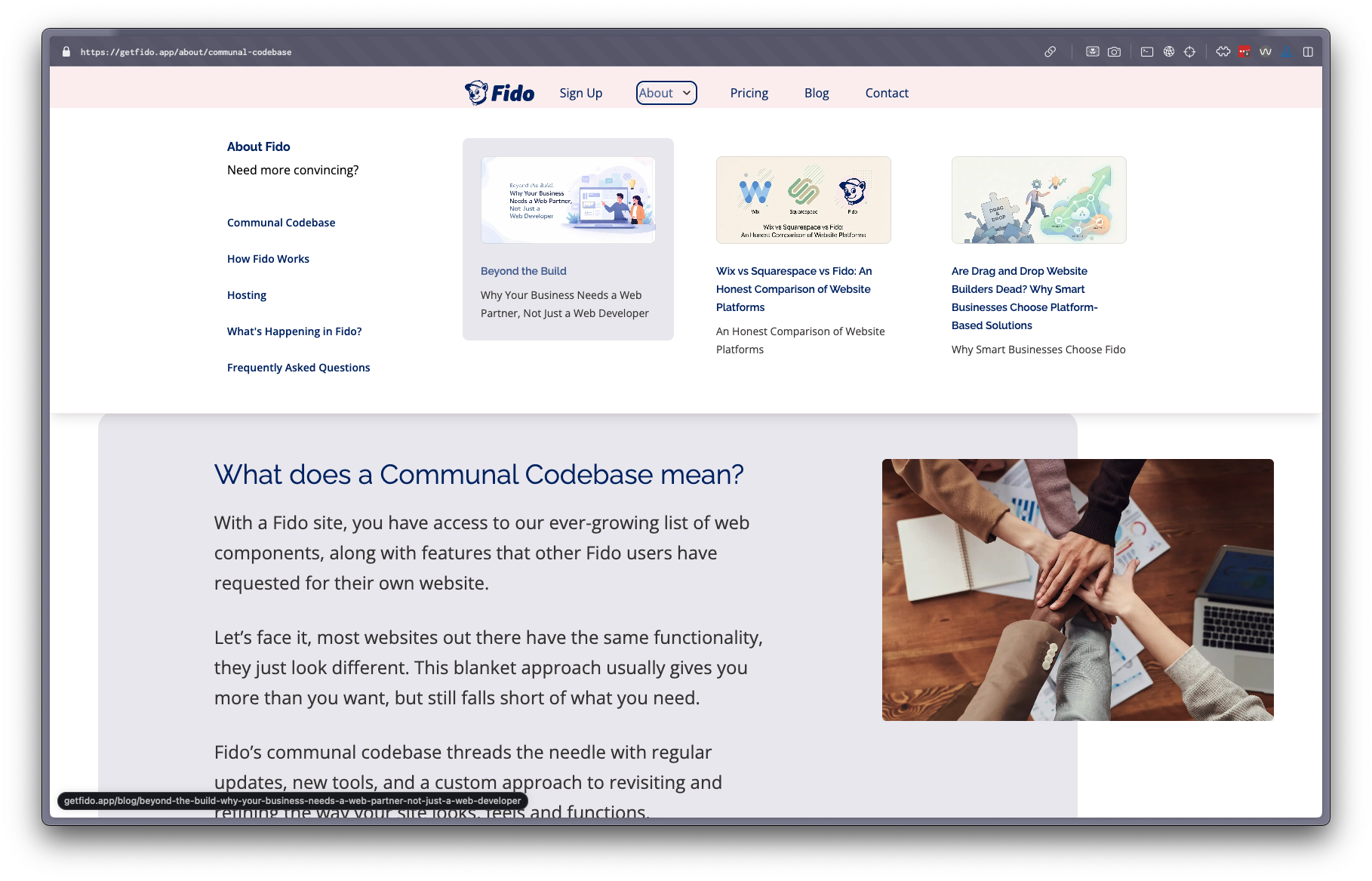
When we find a way to make the platform more secure, we don't just fix it for one person. We update the core codebase, and every single site on Fido gets that update automatically. No "Update Now" buttons. No neon-purple headers. It just works. We’ve even given every site major navigation upgrades for free just because we could. It’s security (and innovation) at scale.
Managed Hosting: The Security Guard That Never Sleeps
When you’re with Fido, you aren't just buying a website builder; you’re getting a partner. Our managed hosting is designed for 99.99% uptime. We handle the server configurations, the firewalls, and the monitoring that usually keep business owners up at night.
Remember that stat about 90% of breaches coming from misconfigurations? We’ve eliminated that risk by taking the configuration out of your hands and putting it into the hands of our experts. We use Craft CMS 5, which is widely considered one of the most secure and flexible systems out there, but we manage it so you don't have to worry about the technical weeds.
The Marketing Tier: Security as a Standard, Not an Add-on
We believe security shouldn't be a "luxury feature." That’s why, even on our Marketing tier, we include: Free SSL Certificates: We handle the installation and the renewals. Your site stays "locked" and trusted without you lifting a finger. Automatic Core Updates: We push security patches and feature updates globally. * Daily Backups: If the unthinkable happens, we can roll you back to a safe version in minutes.
We want you to focus on growing your business, not checking your plugin list. Whether you're considering a migration from WordPress or Drupal or just starting out, we make sure the foundation is rock solid.

A Partnership, Not Just a Platform
At the end of the day, website security is about trust. Your customers trust you with their data, and you trust your platform to stay standing. We take that responsibility seriously. We like to think of ourselves as a web partner, not just a web developer.
Got a question about how we handle a specific security concern? Or maybe you're wondering if your current site is as secure as it could be? We’re always here to chat. We’re not about the hard sell; we’re about building a community of businesses that are faster, better, and a whole lot safer.
Stop Worrying and Start Building
The web doesn't have to be a scary place for small businesses. When you stop trying to DIY your security and lean into a platform designed to protect you, a lot of that "business owner stress" just evaporates.
Ready to see how a managed platform can take the security weight off your shoulders? Check out our honest comparison of Fido vs Wix vs Squarespace to see why smart businesses are making the switch.
Let's make 2026 the year you stop babysitting your website and start letting it work for you. See you on the platform!